Counter-culture Journals (文革)

Counter-culture Journals (文革)

Thursday, August 31, 2006

The End of Suburbia

The new film, The End of Suburbia, explains why we are going to have to dramatically change the way we live in the next few years or this country will collapse. The media hasn’t told us and the politicians are willing to fight wars to preserve our way of life, which includes living way outside the city and using huge gas guzzling vehicles to travel to work, places of entertainment and stores.
Some important points of the film:
1. Developers name their new additions after species they have killed off. If a subdivision is called quail ridge, they killed off all the quail to build it.
2. Trucks not only take up a lot of fuel, they cause us to spend $ millions to maintain roads that can’t be bumpy or the products they ship will be damaged. Our trains are a joke compared to any rail road system in Europe.
3. At our standard rate of gas consumption, alternative fuels such as ethanol won’t work because growing the plants needed to make it, would leave little room left for growing food.


The End of Suburbia part II

They have set us up for perpetual war!

Monday, August 28, 2006

Sex in Public – some women love it

Excerpts from Memoirs of a Drugged-Up, Sex-Crazed YippieTales from the 1970s counter-culture: Drugs, sex, politics and rock and roll
By Steve Otto


By evening I dropped George off at his house. Betty had found a Christian home, a brick house in a middle-class neighborhood, where they let her stay. It was operated by a religious organization that tried to help homeless people get back on their feet. She had to promise her “keepers” she wouldn’t drink or do anything else sinful.
“I’m staying at Doc’s tonight,” I told Betty.
“That’s OK. They wouldn’t allow you to sleep with me at the Jesus home.”
“My lawyer had advised me to move back to Wichita. My parents offered to let me stay with them for a while. What could I say? I have little choice.”
“I understand. After you get a place of your own, I’ll move to Wichita and we can live together. We won’t be separated for long.”
I was on the way to dropping off Betty, when she made a suggestion.
“Turn down that road over there.”
We drove a few blocks to the dead end of a suburban street.
“Let’s park here for a minute,” Betty said.
She got out of the car.
“Come on,” she said as she gestured for me to follow. “What are you waiting for?”
We were in a quiet, middle-class-residential neighborhood. Behind the dead end was a park. We started walking behind the car, away from the dead end. It was about 8p.m. and was just starting to get dark. After we got a few feet past the back of the car, she stopped me and unfastened my pants. Then she undid hers. She pulled both our pants down, sat me down in the gutter and got on top of me. She was in a hurry to have sex. While kissing me, she squeezed me and stroked me until I was hard. She sat on my erect penis. I started pumping up and down. As usual, she wanted to do it again, right after I came. While we were doing it the second time, a car pulled up and its lights were shining on our groins. I could almost feel the bright headlights on my balls.
“Don’t stop,” Betty kept saying, apparently undaunted by the fact that people we didn’t know in a car were watching us. After a few minutes the lights went off. I could hear the car door slam and the occupants going into their home. I couldn’t see who they were. Betty still wanted to do it one more time.
Some people will have sex anywhere.

Saturday, August 26, 2006

I want my planets back


So they stripped Pluto of its status as a planet and now we have just eight planets. We’ve had nine since I was in grade school and I always found a certain fascination for the coldest known world in the solar system. Then theirs Xena, which would have been the tenth planet for sure and an even colder world than Pluto.
Instead we loose a planet and now we have dwarf planets. Or maybe to be politically correct, we should call them “size-challenged planets.”
Since grade school, I’ve found the real interest to be the moons of the four major planets. The most fascinating is that of Titon. The recent pictures show a land that looks remarkably earthlike, with harbors of now dry lakes or seas. The picture from the landing craft shows a smooth rocky world, flat like my homeland and an orange sky. It looks quite pleasant and if I ever find a jeannie to grant me three wishes, one will be to spend an hour on Titon, since I don’t think I will live long enough to see the day when humans can travel there. I’ll barely live long enough to see men on Mars, which would be my second choice of outer-space vacations.
And still, standing on Pluto or Xena, and knowing I was standing at the edge of the known solar system, where the sun is only a large star and there is virtually no heat is still a fascinating thought. Any of these places I go, I’ll need s space soot. Even on Titon, which has an atmosphere similar to the thickness of Earth’s, it’s nearly -300 degrees Fahrenheit and the air is un-breathable. I would need a good space suite. A good fur coat with an oxygen mask just wouldn’t do it.
Still, I miss Pluto and Xena already. What a pisser.


You folks have been ripped off.


Pluto


Xena

Wednesday, August 23, 2006

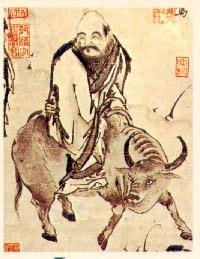
老 子 道德經

: 「道 經」 :

。   無 。   故 。   此

From Lao Tzu – Tao the Ching

Wednesday, August 16, 2006

The joys of Speed-balling

Excerpts from Memoirs of a Drugged-Up, Sex-Crazed Yippie
Tales from the 1970s counter-culture: Drugs, sex, politics and rock and roll By Steve Otto


I was sitting on the brown felt couch in the front room of Frieda’s small white house, in the summer of 1979, when I heard a knock at the door.
“Is George here?” said a young black man, about my height, with short hair.
“I haven’t seen him all day,” I answered.
I let him in the front, green, wooden screen door. The house had a front room, two small bedrooms and a really small kitchen, with the bathroom attached. The front room was cluttered with Frieda’s hats, cloth chairs, beads and other decorations.
“Would you like some yellow coke?” the young man asked.
“Yellow?” I asked.
“Yah! It comes as little yellow flakes. No one will buy it because it’s yellow. No one wants yellow coke.”
“What the heck! I’ll take some.”
He just gave me a little flake. I didn’t expect much to come of it. I thought it was barely worth doing, it was such as small amount. I figured I could mix it with something. I walked back to the kitchen and reached up on a high wooden shelf for a cardboard shoebox that had all my drugs and paraphernalia in it. As it turned out, I found one last Talwin tab that I had overlooked. I rarely overlooked drugs, but I had overlooked this one. Normally one 50-milligram Talwin tab would not do much by itself. Talwin, or pentazocine, is a synthetic narcotic that usually lasts no more than two hours. But I figured that mixing it with that flake of cocaine would give me a slight buzz.
I put the box on the small, brown, wooden table that was crammed between the stove and the kitchen sink.
There was barely any room to walk past the table to the back door of the house. The kitchen had brown walls and the stove was mostly black. I pulled two large spoons out of the silverware drawer and took a three cubic centimeter syringe out of the box. I put nearly 2ccs of hot water on the tablet of Talwin. The pill mushroomed into a cloud of tan milky looking liquid. I strained it through a piece of cotton from a Q-tip then injected the now clear, but tan tinted water in a second spoon which had the yellow coke. The coke instantly dissolved. I strained the whole mixture again, through a piece of cotton and hooked on a 25-gauge needle that was kept separate from the syringe.
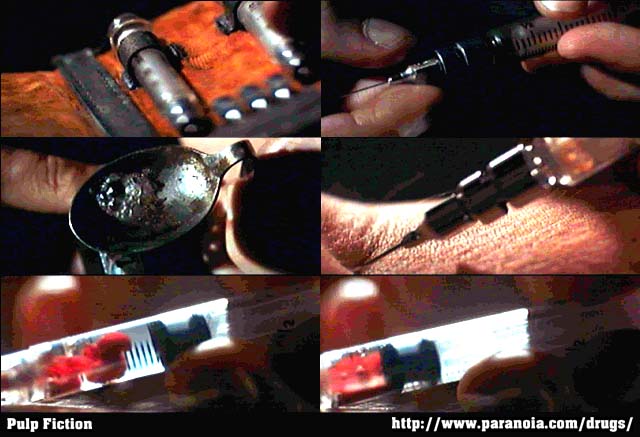
I stuck in the needle and began the process of shooting up. As the drugs went in I could taste ether in my breath. That always happened when shooting coke or Talwin. The rush came immediately after. It was a really intense rush that had the pins and needles effect of cocaine, a tingle similar but not as intense, as MDA, and the feeling of a surge of energy. It also had the Talwin rush, like a warm blanket overwhelming me. I couldn’t believe I’d get that high from such a small speck of cocaine. This was called speed balling, using cocaine with a narcotic. Heroin was more commonly used when it was available. The mixture allows the more intense cocaine rush to prevail, but the narcotic high kicks in and prevents the crash when the coke suddenly wears off.
A few weeks later I bought a High Times magazine in The Town Crier bookstore. After I walked home and sat on the couch, an article caught my eye. Peruvian flake cocaine was the new rage. It was flaky, yellow, and about the purest cocaine to ever hit the market. The stuff was hard to come by here in the Mid-west. I don’t know if George’s friend ever sold anymore of his yellow coke before people realized what it was. If he had any left, I’m sure he didn’t have any trouble selling it once the word got out. I kind of felt sorry for him. He was like a man with a gold coin who thought he had a brass one.


Friday, August 11, 2006

I went camping and escaped my ugly home city

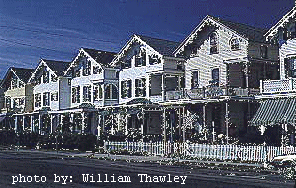
I went camping out this week. It was nice to get away from Wichita, where the only thing I can see from my house are the old houses and the new ones that are all designed exactly the same and all painted dull colors, such as beige, gray or off white.
It seems that ugly homes are in. And for the poor little people, there are some row houses right along Highway 96, so they can hear the traffic, which is about 20 feet from their back doors.
The poor also have only a chain link fence to protect their kids from highway traffic, going 70 MPH. It’s social Darwinism all over again. The rich people have ugly homes in the safer parts of the new developments while the poor live in dangerous places.

But for a few days I saw stars in the sky, without city light to drowned out their presents, real trees, frogs, which have been missing from my neighborhood for a long time and I swam in an actual lake and stream.
I was exposed to wild life and got to sleep in the outdoors. No Quickie Marts, jammed traffic lights, light pollution, no strip malls. It was like a religious experience, only without the mega $ million ostentatious church building.

I drove two hours to a fishing lake several counties over. Who says a little solitude isn’t a good thing. It’s almost as good as a really good drug high.

Saturday, August 05, 2006

More on Socialist Art


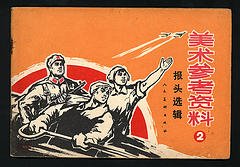
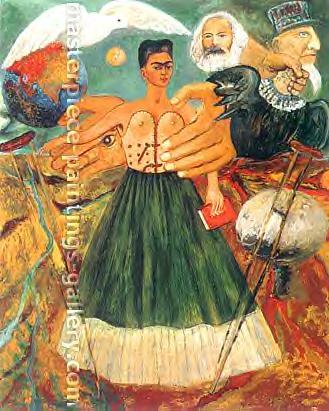
The famous artist Frida Kahlo was known for her unusual symbolic and at times surreal art. In the below picture she has the face of Karl Marx’s face connected to a fist over her right shoulder and a dove and a world globe over the left. It’s a stylish painting in which she was becoming more political as she got older. The other painting, to the right, is a poster from the Chinese Cultural revolution from the 1960s or 1970s. While it has color to it, the characters are mostly black and white and cartoonish, while also being symbolic of various professions. They have some red coloring, which is similar to the style of the graphic novel turned film “Sin City,” written by Frank Miller.
This is a propaganda poster, but it follows the artistic style of many of the comic books that were widely printed and distributed during China’s push to educate adults. Comics were seen as a tool to get people to read, so the country could wipe out literacy.

Tuesday, August 01, 2006

The debate goes on in socialist circles of abstract or surrealism vs. socialist realism


The debate goes on in socialist circles of abstract or surrealism vs. socialist realim.
A new article at a web-site called

"ALLIANCE!" MARXIST-LENINIST Issue 52 April 2003

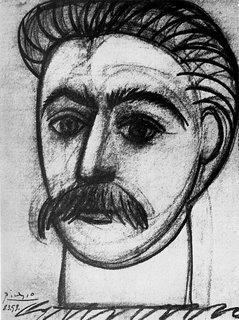
It attats Cubbism that Picasso started, even though he was a communist and his paintings often reflected his politics. In the artcicle:
"The Problem of Pablo Picasso"

He states:

The cubists rejected an "apparent" reality to be conveyed by normal rules of perspective and modelling. They aimed to show all sides of reality, by displaying a moving history of how objects look over time, and from simultaneously observed but differing, vantage points. It was a "cerebral" exercise therefore, and it rejected any simple notion of how "an object looked":
"Cubism made a radical departure from the idea of art as the imitation of nature that had dominated European painting and sculpture since the Renaissance. Picasso and Braque abandoned traditional notions of perspective, foreshortening, and modelling, and aimed to represent solidity and volume in a two-dimensional plane without converting the two-dimensional canvas illusionistically into a three-dimensional picture-space. In so far as they represented real objects, their aim was to depict them as they are known and not as they partially appear at a particular moment and place. For this purpose many different aspects of the object might be depicted simultaneously; the forms of the object were analysed into geometrical planes and these were recomposed from various simultaneous points of view into a combination of forms. To this extent Cubism was and claimed to be realistic, but it was a conceptual realism rather than an optical and Impressionistic realism. Cubism is the outcome of intellectualized rather than spontaneous vision. " I. Chilvers, H. Osborne, D. Farr. "Oxford Dictionary of Art"; Oxford; 1977; p. 144.
As a movement, following its’ birth with "Les Demoiselles d’Avignon", it rapidly evolved into other movements – but it was one of the key sources of abstractionism in art.”

So right away we see that this Marxist Leninist couldn’t stand abstract art. But what is so bad about it. He goes on to attack Dadaism:


Dadaism involved a "nihilism" [""total rejection of current religious beliefs or morals.. A form of scepticism, involving the denial of all existence," "Shorter Oxford English Dictionary" Volume 2; Oxford 1973; ; p.1404.]. The nihilism of these movements "not only questions the value of art but of the whole human situation. For, as it is stated in another of its manifestos, "measured by the standard of eternity, all human action is futile":
"The historical importance of dadaism and surrealism (lies)…. in the fact that they draw attention to the blind alley …. at the end of the symbolist movement, to the sterility of a literary convention which no longer had any connection with real life .... Mallarme and the symbolists thought that every idea that occurred to them was the expression of their innermost nature; it was a mystical belief in the "magic of the word" which made them poets. The dadaists and the surrealists now doubt whether anything objective, external, formal, rationally organized is capable of expressing man at all, but they also doubt the value of such expression. It is really "inadmissible" - they think, that a man should leave a trace behind him. (Andre Breton: Les Pas perdus, 1924). Dadaism, therefore, replaces the nihilism of aesthetic culture by a new nihilism, which not only questions the value of art but of the whole human situation. For, as it is stated in one of its manifestos,
"measured by the standard of eternity, all human action is futile." (Tristn Tzara: Sept manifestes dada, 1920)."

Yet some Marxist have pointed out that Dadaism started out as anti-war and many were communists. So how could this movement have been so dangerouse. One example given by other Marxist is that it was coopted by the capitalist art societies and later revised to promote fascism in Italy. But is any of this the fault of the artist? Are They responsible for those who misuse their art and try to give it contradictory meenings?


In the Conclusion of the article:
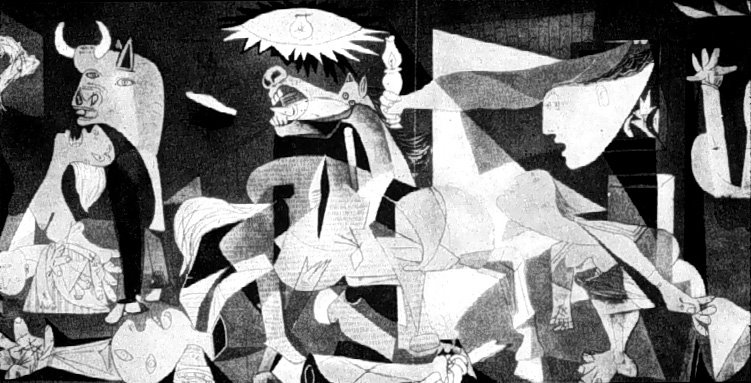
We argue that Picasso ultimately was on the side of the working classes. A "champagne socialist" he may have been – but he did not need to do what he did. As to the worth of his art - where he retained realist images and forms, he showed a power that people understood. But he was constantly reverting to decadent forms and images that placed at an immediate distance between the people and his art. At his best, he moved people. And in that troubling work – "Guernica" – he undoubtedly, has moved and affected generations who have seen it. Again – it is patently, not a piece of "socialist art" – but despite its obvious anti-realist forms, it conveys a very real, and realistic message:
"Down With War!"
Then comes the real killer, the support of socialist realism in the USSR, during the Stalin years.

Impact of Picasso and Guernica on Russian Discussions Upon Socialist Realist Art
A mythology prevails, that there was no discussion - nor knowledge of Western art movements in the socialist years of the USSR (up to 1953). But this is patently false, as there is absolutely no doubt that the Russian artistic scene, was affected by currents in the West. Indeed, the height of knowledge and sensible debates about these various movements is the lie to the general bourgeois line that "there was no debate" and "purely dictatorship" in the USSR. Artistic events in the West were treated very seriously and openly. Undoubtedly post-Second World War there was a renewed debate about the principles of ‘Socialist Realism’:
“At the ninth plenum of the orgkomitet (Organising Committee of the Union of Soviet Artists) held May 1945, some of speakers from the floor brought up the question of innovation in painting, suggesting a new openness to questions of form.... Even court painters and official spokesmen of socialist realism appeared with new faces. The critic V Gaposhkin made a visit to Alexandr Gerasimov's studio and praised highly his unfinished painting of “A Russian Communal Bath' - a major composition of female nudes with no ideological pretext (plate 230). ......... That the mood among some artists and critics, was distinctly rebellious may be may be gleaned from a lecture, entitled ‘The Problem of the 'Impressionism & the problem of the Kartina', delivered by Nikolai Punin to the Leningrad artists' union on 13 April 1946 - and from the reaction to it. Punin's address was an attempt to install impressionism as the basis for the work of Soviet painters; it amounted not only to a revision of the attitude to impressionism which had been imposed in the art press after the debates of 1939-40, but also to a rejection of some of the entrenched principles of socialist realism. He stressed the variety apparent in the painting of the impressionists extolled them as 'honest' and 'contemporary'. He criticised the characterisation of impressionism as some kind of a system..”. Cullerne Bown, Matthew. “Socialist Realist Painting”; New Haven;1998; p.223.
Picasso and his evident partisanship, as expressed in ‘Guernica’ became a part of the debate in the USSR:
“At the discussion on 26 April the artist Petr Mazepov pointed out that impressionism led to the formalist art of cubism and fauvism, in which 'there is no social struggle, the class soul, the party soul, the great soul of the people is absent'.' At this point Mazepov was interrupted from the floor: 'And Picasso?' 'And Cezanne?" And " Guernica, he's a Communist, a party member." A little later Mazepov was interrupted again: 'An artist doesn't have to take up a proletarian position to express his idea'. ................. “


Pablo Picasso’s – "Guernica"


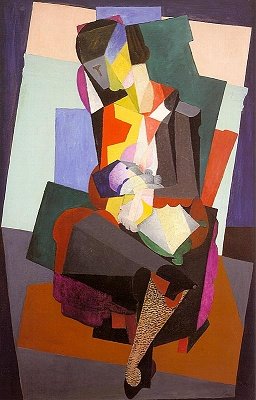
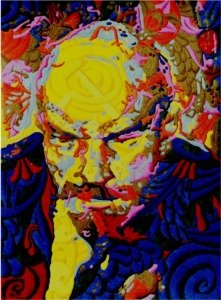
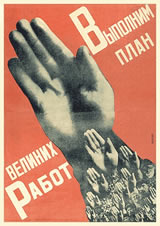
And yet many other Marxist Leninists had been able to promote socialism with out the rigid, humorless stoic Socialist Realism. How about Diego Rivera? He often painted murals, but not all were socialist realism and some where abstract. His wife, Frida Kahlo, also did some unconventional art styles although she repudiated much of her more abstract work right before she died. There was also the Russian Constructivist movement, which was somewhat abstract and fallowed some of the Dadaist formulas. Even the Chinese artist in the Cultural Revolution did not always stick to the rigidness of Socialist Realism. It all had a political slant towards the common man and cadre, yet the form was relaxed enough that some was nearly abstract.


The Art of Diego Rivera


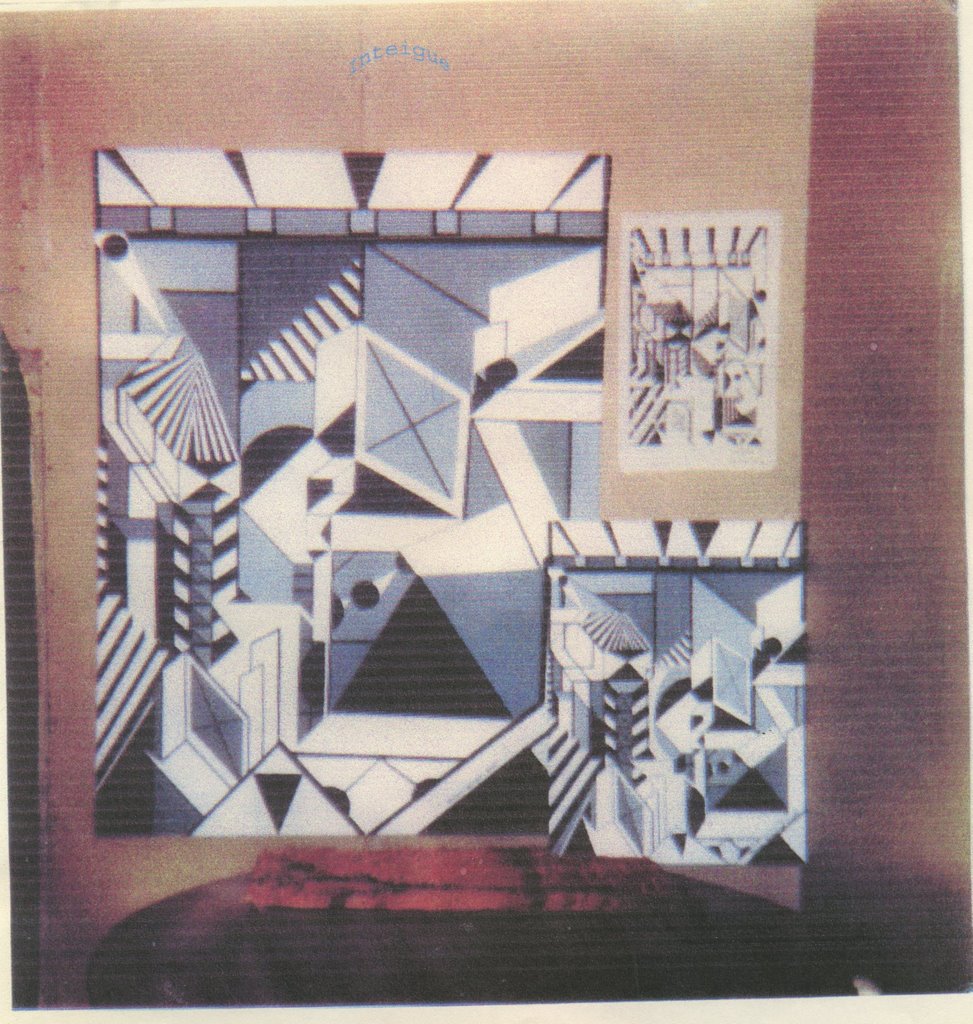
Below is Soviet and Maoist art that is not Socialist Realism. Soviet Constructivist painted mostly from 1900 to the 1920s. The Chinese art is from the Cultural Revolution.

Russian Soviet Constructivist